Goods shipped from Dongguan to Thailand may be transported by sea, road, air, or a combination of different transport modes.
Each option has different characteristics in terms of cost, transit time, cargo volume, and delivery arrangements. A suitable logistics plan should not be selected based on one freight figure alone. The cargo description, weight, volume, destination, expected shipping date, and final delivery requirements should all be considered.
This article introduces the common transport options from Dongguan to Thailand, their suitable applications, and the information customers should prepare before requesting a quotation.
This article provides general logistics information only. Actual routes, transit times, charges, border crossings, vessel schedules, flight arrangements, customs requirements, and delivery conditions must be confirmed according to the specific cargo and the quotation available at the time of shipment.
1. Common shipping requirements from Dongguan to Thailand
Manufacturers and trading companies in Dongguan and the wider Pearl River Delta ship many types of goods to Thailand, including:
- Industrial equipment, machinery parts, and production tools;
- Electronic products, components, and packaging materials;
- Home appliances, consumer goods, and general merchandise;
- Samples, small orders, and urgent replenishment shipments;
- Project cargo, factory relocation materials, and oversized goods.
Different cargo types require different transport arrangements.
Small samples normally place more emphasis on delivery speed. Larger or bulkier general cargo often places more emphasis on total logistics cost. Equipment, battery-powered products, liquids, powders, and other special cargo should be reviewed in advance to confirm transport, declaration, and customs clearance requirements.
2. Transport options from Dongguan to Thailand
2.1 Sea freight
Sea freight is generally suitable for cargo with a relatively large volume or weight and for shipments where the delivery schedule is more flexible.
Depending on the cargo volume and loading requirements, customers may consider:
- Full container load;
- Less than container load;
- Port-to-port transport;
- Transport combined with pickup in China, export customs declaration, and delivery in Thailand.
Full container load is commonly considered when the shipment volume is large or when the customer prefers to avoid loading the goods together with cargo from other shippers.
Less than container load is suitable when the shipment does not require a full container. Actual charges may be affected by volume, weight, port of loading, destination port, warehouse handling, and local destination charges.
For a sea freight quotation, customers should normally provide:
- Cargo description;
- Total weight and total volume;
- Number of packages and packing method;
- Whether the cargo can be stacked;
- Pickup address;
- Destination port or final delivery address in Thailand;
- Whether export declaration and destination delivery are required.
2.2 Road transport
Some cargo shipped from southern China to Thailand may be transported by road, depending on the route, border crossing, cargo type, and final delivery requirements.
Road transport may be considered for:
- Shipments from southern China to certain destinations in Thailand;
- Cargo that requires a balance between cost and transit time;
- Shipments that should move faster than some sea freight options but do not justify the higher cost of air freight;
- Projects requiring coordination of pickup, cross-border transport, and destination delivery.
The suitability of road transport must be confirmed according to the cargo, vehicle arrangement, border crossing, destination city, declaration conditions, and transport capacity available at the time.
Road transport should not be understood as a guaranteed fixed direct service for every type of cargo or every destination in Thailand. The actual route and transfer arrangements must be confirmed in the final logistics plan.
2.3 Air freight
Air freight is suitable for shipments with urgent delivery requirements and for goods with a relatively low weight or volume.
Typical applications include:
- Samples;
- Urgent orders;
- Components required for production;
- High-value products with a small volume;
- Emergency replenishment shipments.
Air freight charges normally take both actual weight and volumetric weight into account. The higher figure is usually an important reference for the chargeable weight.
As a result, lightweight but bulky cargo may cost considerably more than expected when the customer only considers its actual weight.
Products containing batteries, liquids, powders, magnetic materials, chemicals, or other special properties should be declared in advance. Product and packaging information should be provided so that the relevant transport provider can confirm whether the goods are acceptable and what documentation is required.
2.4 Multimodal transport
Some shipments cannot be completed efficiently through one transport mode alone. Sea, road, air, and local delivery may therefore be combined according to the route and delivery requirements.
For example:
- Cargo may be collected from a factory in Dongguan and transported to a designated port or airport;
- Destination delivery may be arranged after the international main transport has been completed;
- Different transport modes may be combined to balance cost and delivery time.
Multimodal transport is not a fixed standard route. It is coordinated according to the actual cargo, origin, destination, delivery requirements, and transport resources available.
3. How to choose between sea, road, and air transport
Sea freight is generally more suitable for large or bulky cargo with a flexible delivery schedule. Important quotation details include volume, weight, container requirements, ports, and delivery address.
Road transport may suit shipments from southern China to certain destinations in Thailand when both cost and transit time need to be considered. The route, border crossing, vehicle arrangement, and customs requirements can significantly affect the plan.
Air freight is suitable for urgent orders, samples, small shipments, and high-value cargo. Customers should provide the actual weight, package dimensions, volumetric weight information, and details of any special cargo properties.
Multimodal transport is useful when the route is more complex or when several stages, such as pickup, international transport, and destination delivery, need to be coordinated.
A request such as “How much does it cost to ship goods to Thailand?” cannot normally produce a reliable quotation without basic cargo information.
A useful logistics proposal must be based on the cargo, route, and delivery conditions.
4. Full container load or less than container load
When sea freight is selected, customers may also need to decide between a full container load and a less than container load shipment.
A full container load may be considered when:
- The cargo volume is relatively large;
- The goods are close to filling a container;
- The customer prefers not to load the cargo together with other shipments;
- Loading arrangements and cargo protection require greater control;
- The shipment should be loaded and transported as one unit.
A less than container load shipment may be considered when:
- The cargo does not require a full container;
- It is a first trial order;
- The shipment volume is relatively small;
- The customer wishes to control the quantity shipped at one time;
- The delivery schedule allows some flexibility.
Less than container load is not always cheaper than a full container.
When the cargo volume is close to a full container, or when goods are oversized, overweight, or non-stackable, the total cost of both options should be compared before a decision is made.
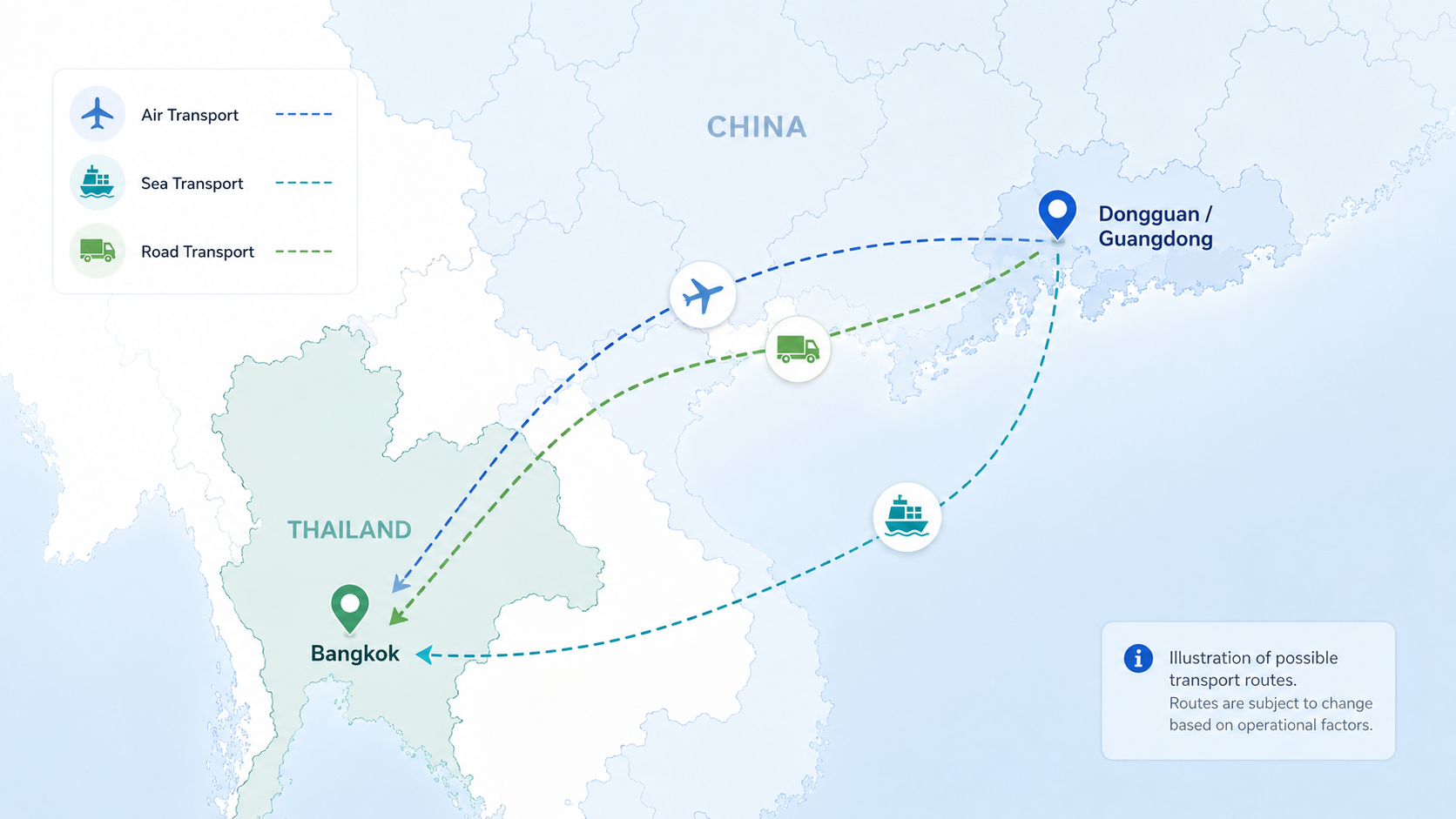
Transport direction illustration only. Actual routes, border crossings, and service arrangements are subject to the cargo and the confirmed logistics plan.
5. Information required before shipping to Thailand
To improve the efficiency of the quotation process, customers should prepare the following information.
Cargo information
- Cargo description in Chinese or English;
- Intended use;
- Material or main components;
- Brand and model;
- Whether the goods are general cargo;
- Whether the goods contain batteries, liquids, powders, magnetic materials, or chemicals;
- Whether special transport conditions are required.
Packing information
- Total number of packages;
- Length, width, and height of each package;
- Weight of each package;
- Total gross weight;
- Total volume;
- Packing method, such as cartons, wooden cases, pallets, or unpacked cargo;
- Whether the goods can be stacked.
Route and delivery information
- Pickup address in Dongguan;
- Destination city in Thailand;
- Final delivery address;
- Whether only port-to-port or airport-to-airport transport is required;
- Whether factory pickup is required;
- Whether export customs declaration is required;
- Whether destination delivery in Thailand is required;
- Expected shipping date.
Trade and declaration information
- Trade terms, such as EXW, FOB, CIF, DAP, or DDP;
- Cargo value;
- Commercial invoice and packing list;
- HS Code or product classification information;
- Whether the importer has the necessary import and customs clearance arrangements.
Final product classification, duty rates, regulatory conditions, and declaration requirements are subject to official regulations, customs brokers, and the results of the actual customs review.
6. Cargo requiring special attention
The following cargo should be clearly declared when requesting a quotation:
- Products containing batteries;
- Liquids, powders, and pastes;
- Chemicals or goods that may have dangerous properties;
- Food, nutritional products, and cosmetics;
- Wooden products or wooden packaging;
- Medical devices;
- Branded products;
- Oversized or overweight cargo;
- Fragile or high-value goods.
Providing accurate cargo information in advance helps avoid unsuitable transport channels, incomplete documentation, or unexpected adjustments to costs.
7. Why freight quotations should not be compared by one figure alone
Different quotations may cover different service scopes.
One quotation may only include the international main transport, while another may also include:
- Factory pickup in Dongguan;
- Origin warehouse handling;
- Export customs declaration;
- Port or airport charges;
- Customs clearance in Thailand;
- Duties and taxes;
- Destination delivery;
- Special cargo surcharges.
Before comparing quotations, customers should confirm:
- Which services are included;
- Which charges are excluded;
- Whether export customs declaration is included;
- Whether destination charges in Thailand are included;
- Whether the cargo will be delivered to the final address;
- How long the quotation remains valid;
- Whether any special cargo conditions or surcharges apply.
Quotations are only comparable when their service scopes are consistent.
8. How to request a quotation for shipping from Dongguan to Thailand
Customers with shipments from Dongguan or the Pearl River Delta to Thailand should prepare:
- Cargo description;
- Pickup address;
- Destination in Thailand;
- Number of packages;
- Weight and volume;
- Expected shipping date;
- Delivery time requirements;
- Whether pickup, export declaration, customs coordination, or destination delivery is required.
RONCO can coordinate sea, air, road, and multimodal transport options according to the actual cargo, route, delivery schedule, and final delivery requirements.