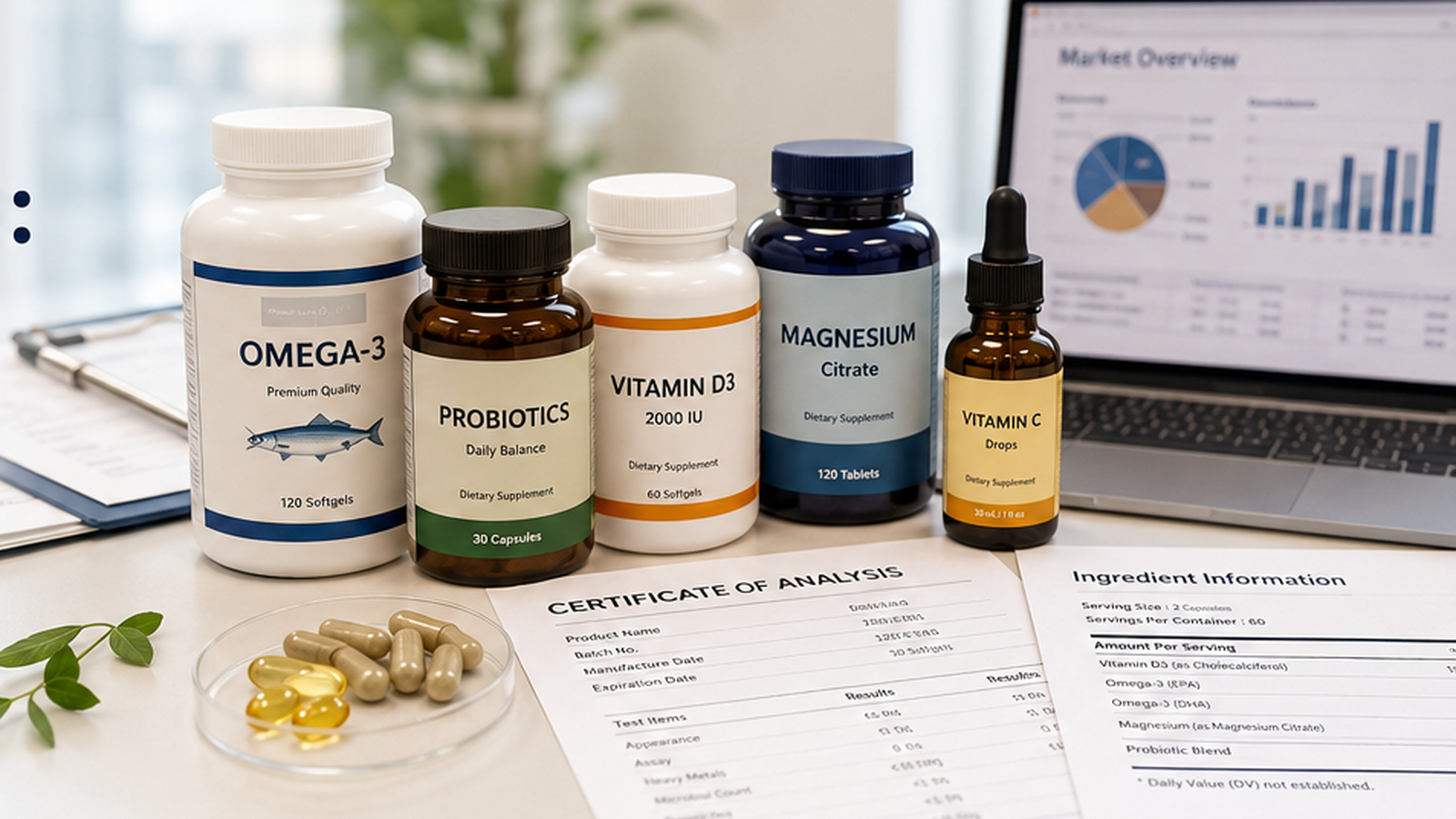
The dietary supplement industry is characterized by rapid product development, diverse subcategories and significant differences between brands.
From vitamins, minerals, Omega-3 and probiotics to coenzyme Q10, botanical extracts, sports nutrition and children’s nutrition, brands continue to differentiate themselves through formulation, ingredient sourcing, dosage form and intended use.
For an overseas brand planning to enter the Chinese market, however, formulation is only the first step.
The practical feasibility of a partnership also depends on several other factors:
- How the product is classified in its country of origin;
- Whether its ingredients and dosage are suitable for the target market;
- Whether labels and promotional claims are compliant;
- Whether the brand can provide complete and verifiable product documentation;
- Whether the price, dosage form and usage pattern suit Chinese consumers;
- Whether the brand is willing to support market testing and long-term distribution.
Competition in the dietary supplement sector is therefore shifting from ingredient-based differentiation toward a broader combination of compliance capability, evidence quality, supply-chain stability and market localization.
1. The Same Product May Fall Under Different Regulatory Systems
“Dietary Supplement,” “Food Supplement” and the Chinese regulatory category of health food are not legally identical concepts.
In the United States, dietary supplements are regulated as a category of food. The US Food and Drug Administration does not normally approve each dietary supplement before it is marketed in the same way that it approves pharmaceutical products. However, companies remain responsible for product safety, labeling and manufacturing quality.
In the European Union, food supplements are regulated as foods. The vitamins, minerals and permitted sources used in these products are subject to relevant requirements. Products containing less-established ingredients may also require an assessment of whether the ingredient is considered a Novel Food.
In China, general trade importation, cross-border e-commerce retail importation, and health food registration or filing represent different market-entry routes. Cross-border e-commerce retail imports operate under a positive-list system, but each product still needs to be evaluated according to its customs classification, ingredients, declaration method and platform requirements.
A product being legally sold in its country of origin does not automatically mean it can enter China without further assessment.
Before discussing importation or distribution, the following points should be clarified:
- Regulatory classification in the country of origin;
- Intended market-entry and trade model in China;
- Ingredients, dosage and dosage form;
- Packaging, labeling and promotional materials;
- Whether the product involves novel ingredients, children or sensitive health claims.
2. Product Claims Increasingly Depend on Verifiable Evidence
A common issue in dietary supplement marketing is not only what an ingredient contains, but how the brand describes its function.
Examples may include:
- Supports normal immune function;
- Helps maintain normal bones;
- Supports energy metabolism;
- Helps maintain normal vision.
Whether such claims may be used depends on the relevant regulatory rules, ingredient conditions, dosage requirements and supporting evidence in each market.
The European Union operates a regulated system for nutrition and health claims. Only claims meeting the relevant conditions and authorization requirements may be used.
In the United States, companies may use certain structure or function claims under specific conditions, but they remain responsible for those claims. Certain claims may also require notification to the FDA. Such claims do not mean that the product has been approved by the FDA.
For overseas brands entering China, promotional statements printed on existing English-language packaging generally cannot simply be translated and used without review.
A more prudent assessment should consider:
- Whether the claim relates to nutrition, body structure or disease;
- Whether it could be interpreted as preventing or treating a disease;
- Whether the ingredient and dosage support the claim;
- Whether the wording is suitable for children, pregnant women or other defined groups;
- Whether packaging, e-commerce pages, advertising and sales communication are consistent.
Adapting claims for a new market does not weaken a product’s value. It helps reduce compliance risk and establish long-term brand trust.
3. Ingredient Sourcing and Formula Transparency Are Becoming Core Competitive Factors
Many products traditionally emphasize the following points on the front of the packaging:
- High strength;
- Complex formulation;
- Natural extracts;
- Made in Europe;
- Free from certain additives;
- High absorption.
These messages alone are not sufficient for a practical partnership assessment.
Importers, distribution channels and consumers may also want to understand:
- Where the ingredients come from;
- Which chemical or nutritional form is used;
- The amount per capsule and the recommended daily intake;
- The excipients and capsule-shell materials;
- Whether allergens are present;
- Whether animal-derived ingredients are used;
- The extraction ratio and standardization of botanical extracts;
- Whether batch-specific testing reports are available;
- The shelf life and storage stability.
For products containing magnesium, calcium, Omega-3, coenzyme Q10 or botanical extracts, products with similar names may differ considerably in ingredient form, purity, stability and formula design.
Overseas brands therefore need more than a product catalogue and price list. Complete technical and quality documentation is increasingly important.
4. Documentation Quality May Matter More Than Brand Size
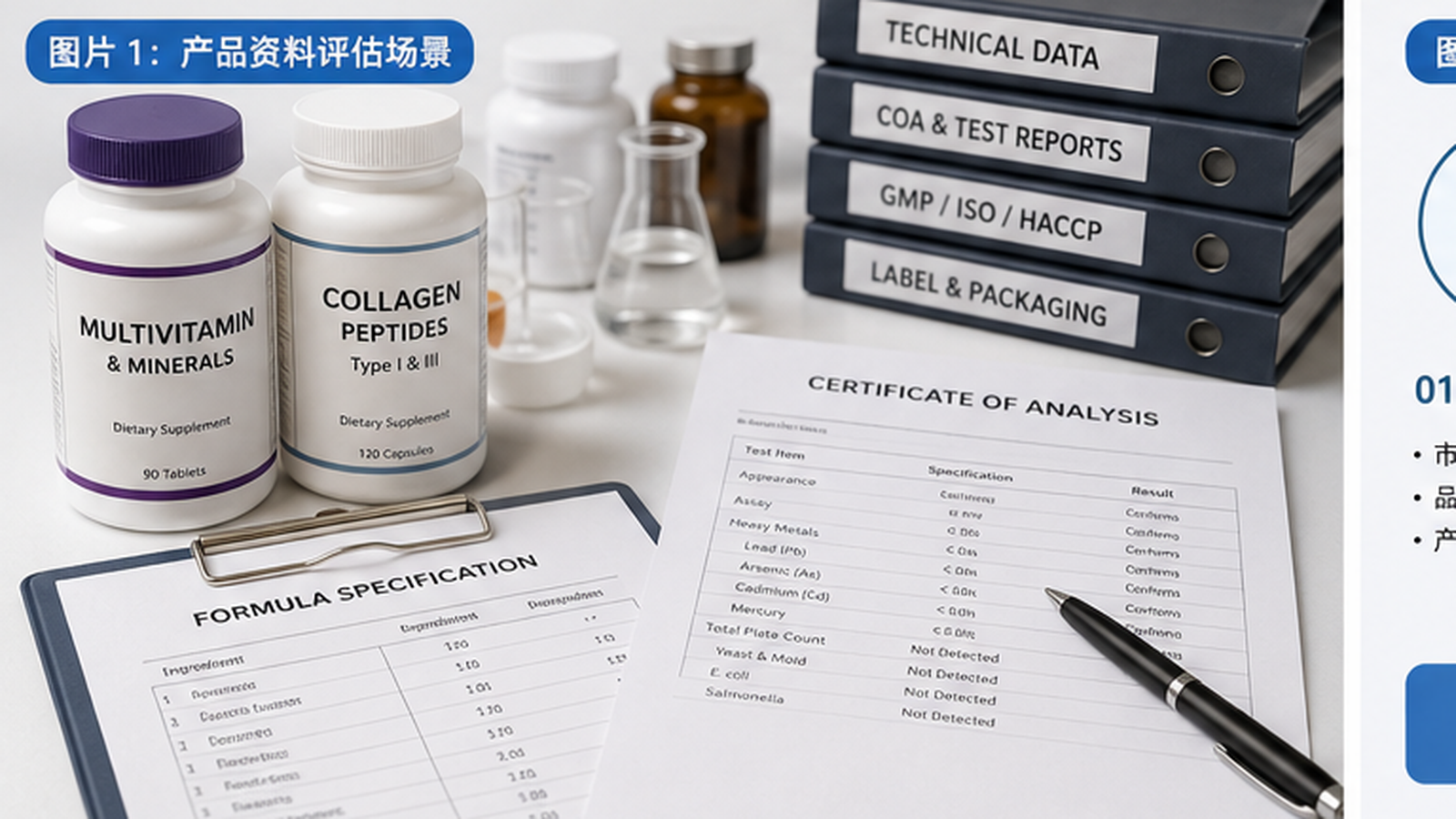
In overseas brand cooperation, many projects stop not because the products lack potential, but because the documentation is insufficient for further evaluation and import preparation.
A relatively complete information package may include:
| Document Category | Main Information |
|---|---|
| Company Documents | Company registration, manufacturer details and brand relationship |
| Product Documents | Formula, specifications, recommended intake and target users |
| Ingredient Documents | Ingredient names, sources, technical standards and suppliers |
| Quality Documents | COA, microbiological, heavy-metal and stability reports |
| Manufacturing Documents | GMP, HACCP, ISO or other valid quality-system documents |
| Market Information | Sales in the home market, key channels and local retail pricing |
| Authorization Documents | Brand authorization, territory and channel scope |
| Packaging Documents | Labels, cartons, instructions and multilingual versions |
| Commercial Documents | MOQ, pricing, lead time, payment and trade terms |
A smaller overseas brand may still have strong cooperation potential when its information is transparent, quality control is stable and its cooperation expectations are clear.
Conversely, even a relatively well-known brand may struggle to proceed when it cannot provide formula, testing, authorization and supply-chain documentation.
5. Popular Ingredients Are Not Automatically Suitable for China
Chinese consumers do not necessarily understand dietary supplements in the same way as consumers in Europe or North America.
Some single nutrients that are already mature categories overseas may still require extensive consumer education in China. Products with clearly understood use scenarios may be more suitable for early market testing.
Before market entry, the following issues should be assessed:
- Whether Chinese consumers understand the ingredient;
- Which genuine consumer need the product addresses;
- Whether professional explanation is required;
- Whether the price fits the target consumer group;
- Whether the dosage form is suitable for long-term use;
- Whether the usage period per package is clear;
- Whether the product could duplicate nutrients in other supplements;
- Whether it is suitable for online content and offline channel presentation.
For example, a single-ingredient magnesium product, a magnesium complex, magnesium with vitamin D, a powder, a tablet and direct-use granules may serve different users and offer different pricing and usage experiences.
Product selection should not rely only on whether a product is popular overseas. It should also consider whether Chinese consumers can understand, try and continue purchasing it.
6. Children’s Nutrition Requires More Cautious Assessment
Children’s nutrition is an important dietary supplement category, but it also involves more sensitive requirements regarding product information, dosage and promotional claims.
When discussing cooperation involving children’s products, a brand should clearly provide:
- Suitable age range;
- Recommended daily intake;
- Dosage differences between age groups;
- Allergen information;
- Sugar, sweetener and flavoring information;
- Safety instructions for capsules, gummies, drops or powders;
- Potential accidental-consumption risks;
- The product’s actual regulatory category in its home market;
- Evidence supporting any claims relating to children.
Adult formulations and marketing logic should not be applied directly to children’s products.
When assessing children’s nutrition products, RONCO places greater emphasis on safety, clear dosage, complete documentation and long-term usage logic rather than exaggerated claims about a single ingredient.
7. Cross-Border E-Commerce Can Support Market Testing, but It Is Not a Compliance Shortcut
For overseas brands that have not formally entered China, cross-border e-commerce retail importation may provide one possible market-testing route.
It can help a brand observe:
- Consumer acceptance of the price;
- Which SKUs are easier to understand;
- Whether the repurchase cycle is reasonable;
- Which ingredients and usage scenarios attract attention;
- Whether packaging, dosage form and instructions need adjustment.
However, cross-border e-commerce does not mean that every overseas product can be sold directly.
Companies still need to confirm:
- Whether the product is covered by the applicable positive list;
- Whether the ingredients and product attributes are suitable for declaration;
- Whether the platform and bonded warehouse will accept the product;
- Whether product documentation is complete;
- Whether promotional content complies with platform and advertising rules;
- Whether the product is appropriate for personal-use consumption.
Cross-border e-commerce is therefore better treated as a market-testing channel with clear boundaries, rather than a way to bypass product assessment and compliance preparation.
8. Four Preparations Before Entering the Chinese Market
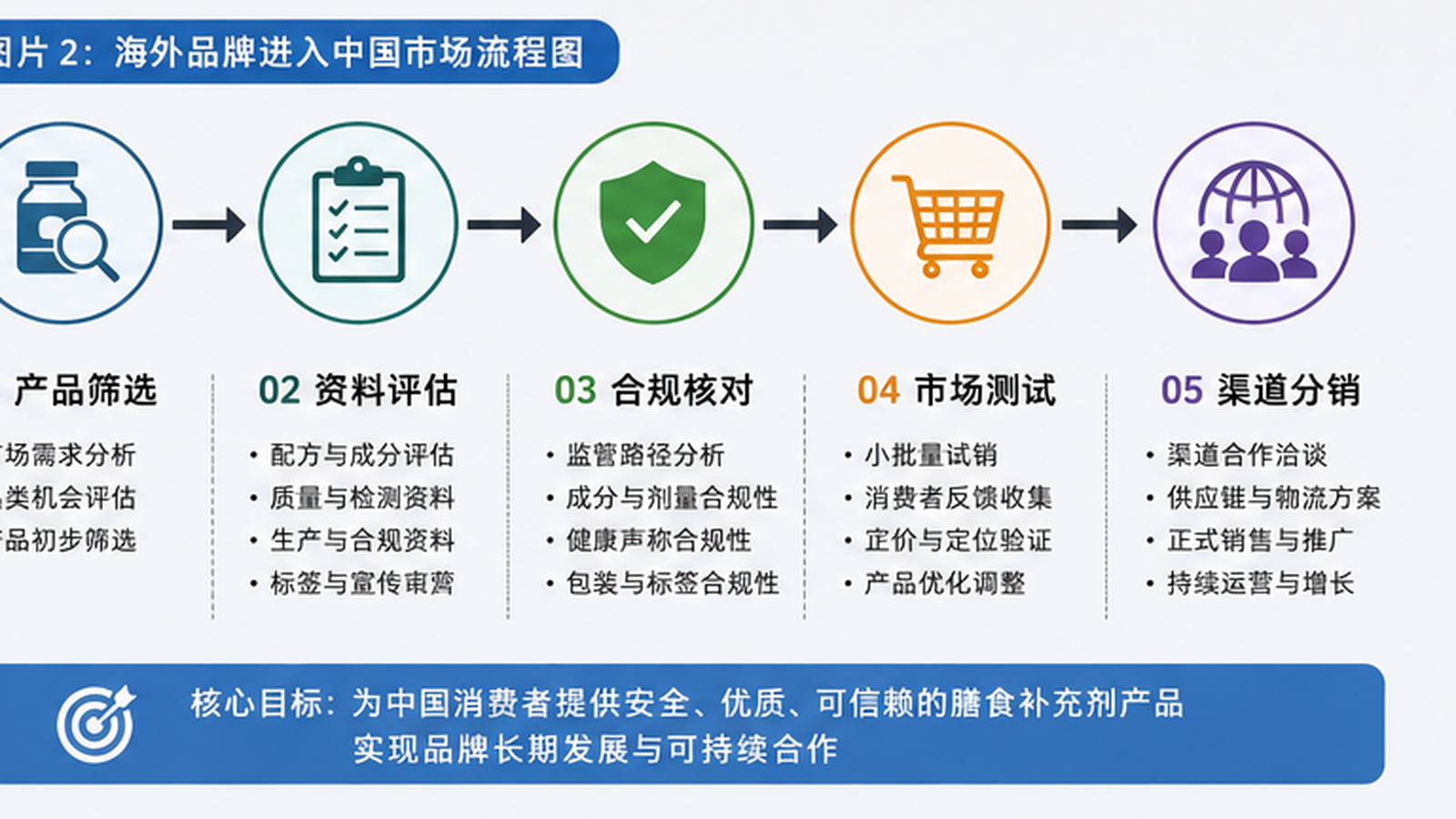
From a practical cooperation perspective, an overseas dietary supplement brand should complete at least four preparations before entering China.
1. Define the Products and Target Consumers
A brand should not introduce its entire product range at once.
A more practical initial selection may include:
- One or two adult foundational nutrition products;
- One product addressing a focused consumer need;
- One product with clear brand differentiation;
- One product suitable for testing repeat purchase.
2. Prepare Complete Product Documentation
This should include formulation, dosage, testing, manufacturing, labeling, authorization and market information.
The more complete the documentation, the more effective the market assessment and import-route evaluation.
3. Reassess Promotional Language
Packaging and promotional claims used in the home market should not automatically be treated as suitable for China.
Health claims, target users and usage instructions should be reviewed before market entry.
4. Accept Small-Scale Market Testing
The initial objective should not be rapid market coverage. It should be to verify:
- Whether consumers understand the product;
- Whether pricing is reasonable;
- Whether customers are willing to repurchase;
- Whether channels are willing to recommend it;
- Whether the brand has the basis for a long-term partnership.
Conclusion
The dietary supplement industry continues to offer diverse product opportunities, but the market-entry threshold is no longer simply about finding a product with an attractive selling point.
For an overseas brand planning to enter China, the important questions include:
- Is the product safe, clear and verifiable?
- Can the brand provide complete documentation?
- Are promotional claims supported by appropriate evidence?
- Are the formula and dosage form suitable for Chinese consumers?
- Is the brand willing to begin with market testing?
- Does the product have the potential for long-term distribution and repeat purchase?
RONCO continues to explore cooperation opportunities in adult nutrition, children’s nutrition, natural skincare, sports and outdoor products.
Where brand authorization, product documentation and compliance conditions are in place, RONCO can engage with overseas brands on product selection, documentation assessment, supply-chain coordination, market testing and distribution cooperation in China.
---
Information Sources
- U.S. Food and Drug Administration, Dietary Supplements Guidance and Regulatory Information
- U.S. FDA, Current Good Manufacturing Practice for Dietary Supplements
- European Food Safety Authority, Food Supplements and Health Claims
- European Commission, Food Supplements, Nutrition and Health Claims, and Novel Food
- General Administration of Customs of China, Cross-Border E-Commerce Retail Import and Positive List Information
Disclaimer
This article is based on publicly available regulatory information and cross-border trade scenarios. It is intended for industry information purposes only and does not constitute nutritional, medical, product registration, legal or fixed import advice. Whether a specific product may enter the Chinese market must be assessed separately according to its formulation, dosage, ingredients, labeling, trade model and applicable regulatory requirements.